Showing posts with label book review. Show all posts

Thursday, July 11, 2013

Not totally serious--yet

Zing, zing, zing. Seems like this year, there goes my summer. That’s probably true every summer, but this one, times three. So, here goes on what I trust (cross my fingers) is the last update on the ongoing melodrama of Trilla’s personal life—in the next few months, it’ll be more about Trilla’s book life.
Foster is happy to be home with his
own food bowl. "Feed me!"
Ginger doesn't mind being an
only cat again. Not on bit.
            The doctor told Kate to stay with us two months. That lasted about two-and-a-half weeks.  She’s back at work, but still can’t put weight on left leg at all, and so this means we’re still helping out lots, but we’re all easier on our own turfs. Happiest of all with the arrangement? No surprise—Foster Cat.
So my “reading just for fun days” have slowed and I’m turning to other books, but still reading lots and lots and lots and lots. And I’m not totally serious yet. I had a great fling, and a good transition with Susan Wittag Albert’s Widow’s Tears.  (http://www.amazon.com/Widows-Tears-Bayles-Wittig-Albert/dp/0425255727/ref=sr_1_1?s=books&ie=UTF8&qid=1373379759&sr=1-1&keywords=widow%27s+tears+susan+wittig+albert).  A great story, particularly if you, like I am, a longtime friend of China and Ruby.  But it’s more than just a story. Albert packs lots in there.  Not really escapism, and it’s set in the beautiful countryside around Round Top, Texas—a place I love.  Indeed, I recommend it.
            Then being a reviewer for Story Circle Book brought me just what I needed! Home Front Girl: A Diary of Love, Literature, and Growing Up in Wartime America appeared at the front door as if on cue. I’ve been journaller about as long as I can remember. A one-year diary showed up under the Christmas tree every year with the same dependability as the doll at top of the red stocking, and continued even after the dolls went away. I made my most recent entry this morning. Part of my life. I was ready, ready for this book.
Joan Wehlen Morrison was a greater journaller than I. What’s more, while I assume “no one’s ever going to care about these” and store them helter-skelter and here-and-there, Joan wrote thinking that her journals would be read, stored them carefully, and made sure her writer daughter knew where they were.  That daughter, Susan Morrison has turned these journals into a story of both her mother’s life from when she turned 14 in December of 1936 to 1943 when she met her future husband of 66 years. But Morrison has done more. She’s captured a slice, a small slice but an important one, of American history. This is an important book.
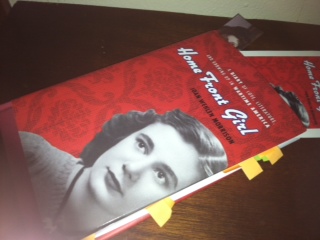
Well read now, and I'll be reading it again.
            And inspirational to me. My next get-organized is not going to be the mess under the kitchen counter that’s on the schedule now. No. I’m going to take those boxes of disorganized mixed-up journals and diaries and get them in chronological order, and then, I’m going to read them.  It may be that some do indeed need discarding—I’ll do it now, and I’ll be the one to do it. But others I’ll keep and who know, while likely they will never be published, someday great or great-great grandchild may enjoy knowing what twentieth-century life was like in the Panhandle of Texas.
            Thank you Morrisons.
            More to the moment, I’m thinking about my weekend reading. Young Joan reported hearing and puzzling over the stance of Charles Lindburg in the time leading up to the war. I knew Kate  read and enjoyed the fictional account of Anne Morrow Lindburg’s life, Aviator’s Wife. I knew it was lying on her bedside table.  Yesterday when I visited Foster, I nabbed the book. Now it’s on my bedside table with the first two chapters consumed—and it is not the weekend yet.
Waiting for bedtime and Chapter 3, maybe 4.

(This entry is also posted at http://storycirclenetwork.wordpress.com)


Sunday, August 28, 2011

Good reading weather


August in Houston--the best thing to do is stay home with a
good book and a mammoth glass of iced tea. 
Wow it’s hot in Houston. Yesterday, Whitey the 10, maybe 11, year old Jeep complained about it. It’s an old man in Jeep years, and never, not once, no, never had his thermometer rolled around to 110 degrees. “Hey,” he yelped in Jeepanese, “I didn’t know I could go that high. Now cut it out or get me air conditioning.”
            We haven’t managed the air conditioning, but we do have a nice shady carport. Whitey’s been spending lots of time there, because it’s also too hot for me. I’m not out running around; I’m in the nice, cool house reading. It’s been a reading summer.
            Since I’ve gone off on my history of the New Deal—more about that in an entry soon, it’s a major project—I’ve been reading lots of history and fiction from that period. But the last couple of weeks, I’ve been reading for fun, and fun it is.
            I got an e-mail teaser from Amazon about The Call, about a small town New England veterinarian and his family. I don’t remember now why it appealed to me, except maybe that New England is cool; I ordered it. I’m in love. In love with the story and with the writing of Yannick Murphy. I was totally unfamiliar with her. Now I have one of her children’s stories for darling Dasha, my granddaughter and her novel about Mata Hari on order. Good, good reading.
            David Appleton is the vet. He puts me in mind of  Steinbeck’s description of “Doc” Ricketts in Cannery Row, "Doc has the hands of a brain surgeon, and a cool warm mind. Doc tips his hat to dogs as he drives by and the dogs look up and smile at him. He can kill anything for need but he could not even hurt a feeling for pleasure.”  
            In the unusual format of a call log (hence, The Call) David brought me into his family, in to sympathy with his long suffering writer wife Jen (Murphy is married to a New England vet—hmmmm, I wonder?), into the family.
            It’s a book I recommend. Man, do I recommend it.
Check it out. And, say, if you like it, mark the box. (Thanks.)
            This should be up on the Story Circle Book Reviews in a few days as well.
            Now I’m off to read my next fun book—Cocktail Hour Under the Tree of Forgiveness by Alexandra Fuller. I read her Don’t Let’s Go to the Dogs Tonight. It’s a trip to Africa. If you need me, I’ll be in Rhodesia this evening.

Saturday, July 30, 2011

Someone's in the kitchen


This book confused me. Not too many pages in, and I didn’t know what to do. Turn on the light as evening fell, skip dinner and keep on reading? Go to the kitchen, roll up my sleeves, pull out the pans and start cooking (oh! that garlic sauce on page 126)? Or head for the computer to order Mastering the Art of French Cooking, maybe with overnight delivery?
            I read.
            But the next day, I cooked and ordered. Glad I am that I did all three.
            On first glance the book seems like a simple enough approach—a compilation of letters between two friends as their individual and interesting lives unfold an ocean apart. But, the two friends are Julia Child and Avis Devoto, both gifted writers. The letters alone zing off the page as they offer not only reports of their personal lives, but a study of a growing, rich and deep friendship, commentaries on the confusing world of the 1950s, the even more confusing world of book publishing, and, naturally, cooking, eating, parties, planning, more cooking, cooking , cooking. I ate it all up.
            In 1951, a young American living in Paris read Bernard DeVoto’s column in Harper’s. He lamented being unable to find a kitchen knife that an American housewife “can cut something with.” The American, Julia Child, knew about knives and where to get exactly what he sought. Off she went, bought a knife, put it in the mail.
            DeVoto, a busy man and popular author didn’t respond. His equally busy and talented wife Avis did with a more-or-less routine thank you note. Julia answered Avis. Avis wrote back to Julia. Years of writing and friendship began.
            Here’s an aside concerning the DeVoto family. It’s a familiar name to me. My dad about whom I’m blogging (http://toucthepast.blogspot.com/ more about that another time—another time soon) was a journalist-historian of Texas and the Southwest. He greatly admired Bernard DeVoto and owned many of his books. I grew up with The Year of Decision, 1846 and Across the Wide Missouri. I never, until now knew or even wondered much about the author—just another famous writer. And I never thought to wonder about his wife although I knew my dad would never have enjoyed the career he had as a writer without the support, help (writing and otherwise), hard work of my mom. This was the case in the DeVoto household. Avis was a writer/reviewer in her own right; plus, she acted as the business manager, the personal secretary, the proof-reader, and, I suspect, sometimes co-author. I have a new heroine.
            More than a half-century after they wrote the letters I’m grateful that both women were not only fine writers and dependable correspondents, but that they both kept things. I recently came into possession of box full of my father’s letters to my mom. She kept things. Apparently he didn’t. Now I ache for her letters to him. Three cheers for Avis and Julia.
            As their friendship grew, so did the range of the letters. Of course, there was lots of cooking, and entertaining. Together they wrestled around with a perennial hostess problem—how to throw an elegant dinner party without help and without the hostess being held hostage in the kitchen by the demands of a “serve immediately” menu.  They’ve got some dandy solution—some show up in Mastering the Art. Politics took up lots of space coming to a peak during the outrageous and outraging McCarthy hearings. And, naturally, they spend lots of time discussing the perennial “what happens next in my life?” The friends are candid and engaging. Avis knew the ins and outs, the snarls and the pitfalls of publishing. She gave Julia more than just advice on writing and managing unruly co-authors, she shepherded Master the Art of French Cooking across the decade, yes, I said the decade, until its triumphant publication in 1962.
            The friendship was not always in letters. Exchanging over 100 letters, the nw fast and best friends met. The friendship deepened and became not only between the women, but between the families. It continued as long as both lived.

Lamb with garlic sauce. Ohhhhhhhhhhhhhhhhhh!
            A great story, a great friendship, a great book, two great lives, and lots and lots of good times and food. My two word review: Read it.

Tuesday, June 28, 2011

Poems of Awakening

Poems of Awakening

I'm still busily reading and reviewing for Story Circle Book Review--and sometimes other places. Here's my latest. It a great nature-based poetry anthology. Read it under a tree or by a river. Watch out folks with birthdays coming up!


Poems of Awakening: An International Anthology of Spiritual Poetry

Betsy Small

Outskirts Press, 2011  


Early in the morning, late at night, in quiet times and busy ones—there is a poem for the moment. Betsy Small, a practicing yoga as well as a professional musician has combined her skills and talents to bring together an array of works from across the globe and across time. Her well-accomplished goal she tells us in the introduction is to offer the works of poets who share their “experiences of living joyfully in the moment. . .”
            The selection of authors speaks to Small’s arduous efforts to reflect the world: generally know names like Mary Oliver, Sara Teasdale , May Sarton, and e.e. cummings join the less familiar Dogen Zenji, Uvanuk, and Zagajewski. Despite the variety, each selection speaks to a moment.
            Reflecting the author’s yoga background and designed by her to be used as part of yoga practice (savasana), the anthology will have a broader appeal. Any person who relishes her life, her days, will find moments to appreciate and to identify with from the majesty of the earth and her creatures (Mary Oliver’s “Wild Geese,” Wendell Berry’s “Sabbath Poem”) to the mundane busyness of daily life, finding glory in washing a wine glass, seeing crockery as a mandala, or letting in a cat to dine and share a bed (May Sarton’s “New Year Resolve”).
            Small suggests that while a “reader can savor poems individually, as integral elements of sets, or as part of the entire collection, which can be read in one sitting as a poetic essay consisting of linked sets.” I chose to do the latter, grabbing my book and heading for a nearby park where I could sit on the ground beneath an old oak tree.
            I recommend the experience. The intertwining of the emotions of the selections is powerful. But once, or, at least, once in a while, is probably enough. For the most part, I plan to keep the book on my reading table where I can often reach out for a poem that allows me to find joy in the moment at hand.


Monday, May 30, 2011

Sudden memories


Grandmother and Grandfather Nordyke on the
Callahan County, Texas farm. The grey Chevy
is parked under the cottonwood in front.
Have you ever been reading a book and suddenly swept up by it, you land right in the middle of your own memories? That’s what happened when I read the first chapter of The Sound of Windmills by Jackie Woolley. She so described life on a hard scrabble Texas farm in the 1940s that all of a sudden I was back in the grey Chevy going to visit my grandparents on that on-the-edge farm where my dad grew up.
Here’s the review I wrote of this book for Story Circle Book Reviews. ( You can read my review at http://storycirclebookreviews.org/reviews/windmills.shtml.


The Sound of Windmills
Jackie Woolley
The trip to see Grandmother and Grandfather on their family farm on the semi-arid, windy, and lonely edge of west Texas delighted this little girl. As we drove up the dirt road in our old gray Chevrolet, I bounced all over my side of the back seat knowing I was going to have so much fun--gathering eggs, watching Grandmother milk the cow, walking down to Greenbriar Creek to gather dewberries, not to mention gobbling up the dewberry cobbler that came out of the woodstove just a little later. All of this played out  to the background serenade of the whirring windmill. It was lots of fun for a city girl, but not so much for the couple who wrestled their living from these 287 acres for most of their adult lives. It remains a memory I treasure: not only for the fun but, now, for the character and good natures of these two strong people.
            All these memories and many more, came rushing back as I read Jackie Woolley's multigenerational saga of the Taylor family. Myra and Joel Taylor live with their daughters, Marilyn and Rugene on a working farm, much like my grandparents', near the fictional town of Langor, Texas. It's a hard life, and Woolley has an excellent eye and ear for it. I do not know exactly how much of this story is autobiographical; I suspect, quite a bit.
            The hardness of farm life is made even harder for the Taylor family because as the story opens, Joel, a polio victim, is dying. Myra, who has done most of the farming and managing for years, expects to carry on with the help of her daughters and a trusted hand, but after Joel's death, their long-time landlord (they are sharecroppers) mercilessly tosses them out within days. Stricken, Myra lands on her feet, and begins to form a new life for the three. This is the true beginning of the long story.
            The focus is primarily on the younger daughter Rugene, a strong spirit and sometimes lonely bookworm. She is determined to go the college and find a life for herself but not in Langor. At the same time she is determined that "I'll be back someday. I'm going back to buy the old farm.” Rugene manages to live much of her dream. Meanwhile, Marilyn and Myra also struggle with their own lives and as well as with holding the three of them together as a family.
            Because the novel spans several decades, it might have been confusing to a reader. What is happening to whom and when?  Woolley handles this problem skillfully by working historic happenings into her story without being obtrusive. The book is no one-night read. It is a rather daunting 545 pages, and is full of twists and turns; however, the main story moves nicely along holding the reader's interest. By the time it comes to a close most of its issues are resolved and three strong women are at peace with themselves and with each other.